Blog Credit : Trupti Thakur
Image Courtesy : Google
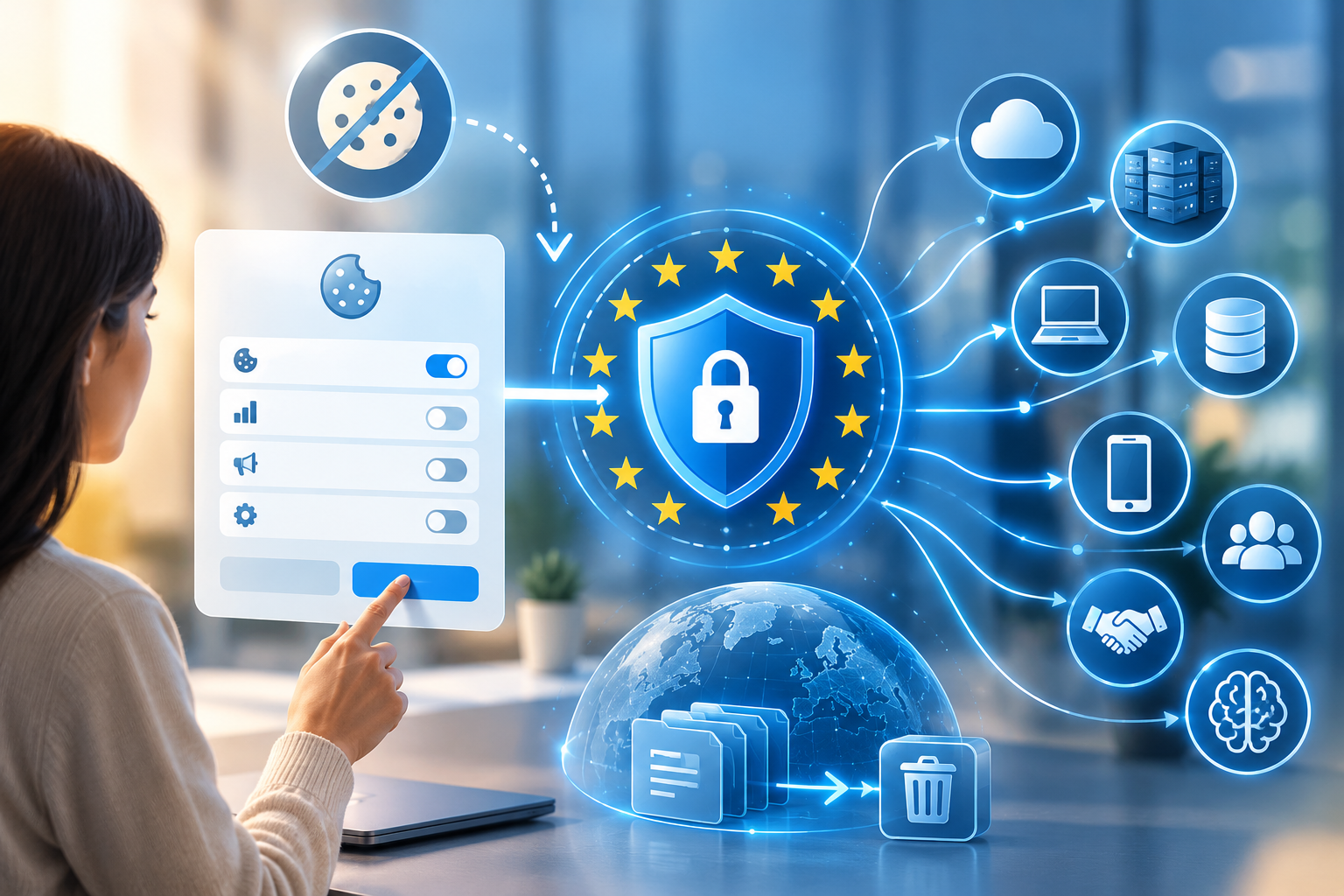
Consent Is Not Control
In the digital world, privacy compliance is often reduced to a familiar question: “Does your website have a cookie consent banner?”
While cookie banners can be an important part of privacy compliance, they represent only a small piece of the GDPR landscape. A user clicking “Accept” does not automatically make an organization compliant, nor does it give an organization unlimited permission to collect, use, retain, or share personal data.
Consent is a legal mechanism. Control is a data governance capability.
That distinction is becoming increasingly important as organizations collect personal data across websites, mobile applications, SaaS platforms, AI systems, analytics tools, marketing platforms, and third-party ecosystems.
The Cookie Banner Is Only the Starting Point
Under the General Data Protection Regulation (GDPR), consent must be freely given, specific, informed, and unambiguous. Individuals should also be able to withdraw consent as easily as they provided it.
This means that a simple banner saying “By continuing to use this website, you agree…” may not provide meaningful consent.
Organizations need to understand:
- What personal data is being collected?
- Why is it being collected?
- What is the legal basis for processing?
- Who receives or accesses the data?
- How long will the data be retained?
- Can the individual withdraw consent?
- What happens after consent is withdrawn?
- Can the organization actually stop the associated processing?
The last question is particularly important.
Consent Without Control Creates Privacy Risk
Imagine a user accepts analytics cookies today and withdraws consent tomorrow.
The organization may update the user’s preference in its consent-management platform. But what happens to the data already sent to analytics platforms, advertising networks, CRM systems, data warehouses, backups, or other third parties?
This creates a fundamental privacy challenge:
Changing a consent preference is easy. Controlling the entire downstream data lifecycle is not.
Effective GDPR compliance therefore requires organizations to connect consent management with their broader data architecture.
GDPR Is Bigger Than Consent
Consent is only one possible lawful basis for processing personal data. Depending on the processing activity, organizations may rely on other lawful bases such as contractual necessity, legal obligations, legitimate interests, or protection of vital interests.
Therefore, treating consent as the foundation of every processing activity can itself create compliance problems.
A mature privacy program instead asks:
“What is the lawful basis for this specific processing activity, and can we demonstrate that the processing remains within that purpose?”
This shifts the organization from consent collection to processing accountability.
The Real Challenge: Data Lifecycle Control
True privacy compliance requires visibility throughout the personal-data lifecycle:
Collection → Processing → Sharing → Storage → Retention → Modification → Deletion
At every stage, organizations should know what happens to the data and who has access to it.
For example, when an individual withdraws consent or exercises a GDPR right, the organization may need to identify relevant information across multiple systems—not just the website where the original consent was provided.
This can include:
- CRM platforms
- Marketing automation systems
- Cloud storage
- Data warehouses
- Application databases
- Customer-support platforms
- Analytics tools
- Third-party processors
- Backup environments
- Logs and monitoring systems
- AI and machine-learning environments
A cookie banner cannot provide this level of control.
The Third-Party Problem
Modern organizations rarely operate in isolation.
Personal data may move between an organization and dozens of vendors, processors, cloud services, analytics platforms, advertising technologies, and business partners.
This creates another important question:
If an individual changes their privacy preference, can the organization ensure that relevant third parties respond appropriately?
GDPR compliance therefore requires more than collecting consent. Organizations need effective vendor governance, data-processing agreements, data-flow visibility, and mechanisms for managing individual rights across the processing ecosystem.
Privacy Rights Must Become Operational
GDPR provides individuals with several important rights, including rights related to access, rectification, erasure, restriction, portability, and objection.
These rights cannot remain merely statements inside a privacy policy.
Organizations need operational processes to identify, verify, track, fulfill, and document requests within the applicable regulatory timelines.
For example, a Right to Erasure request should trigger more than deleting a customer profile from one application.
Organizations should be able to determine:
Where does this person’s data exist, who received it, and where must the deletion or restriction action propagate?
This is where data discovery, classification, lineage, retention management, and identity-based data mapping become critical.
From Consent Management to Data Control
A mature GDPR program should therefore move through three levels:
Level 1 — Consent Collection
The organization obtains and records consent appropriately.
Level 2 — Consent Management
The organization allows individuals to modify or withdraw their choices and maintains accurate consent records.
Level 3 — Data Control
The organization can actually enforce those choices across systems, processing activities, third parties, retention periods, and data repositories.
Level 3 is where meaningful privacy governance begins.
The Security Connection
GDPR compliance and data security cannot operate as completely separate functions.
Even when processing is lawful, weak security controls can expose personal data to unauthorized access, alteration, disclosure, or loss.
Organizations should therefore connect privacy governance with security controls such as:
- Access control and least privilege
- Encryption
- Data classification
- Data-loss prevention
- Secure deletion
- Logging and monitoring
- Third-party risk management
- Data retention controls
- Incident and breach management
- Regular privacy and security assessments
The objective is not simply to prove that a user clicked “Accept.”
The objective is to demonstrate that the organization can control personal data throughout its lifecycle.
The Future of GDPR Compliance
As organizations increasingly adopt AI, advanced analytics, cloud platforms, and interconnected digital ecosystems, personal data can travel farther and faster than ever before.
The future of GDPR compliance will therefore depend less on “Did we get consent?” and more on:
“Can we demonstrate control?”
Consent should be treated as one component of a broader privacy-control framework—not as a compliance checkbox.
A cookie banner can capture a choice.
Only a mature data governance architecture can enforce it.
Final Thought
The most important question for organizations is no longer:
“Do we have a GDPR consent mechanism?”
It is:
“If an individual changes their mind about how their data is processed, can our organization actually make that change happen everywhere it matters?”
That is the difference between consent management and genuine data control.
And in the modern digital environment, GDPR compliance must deliver both.
Blog By : Trupti Thakur
06
OctConsent Is Not Control
Oct 06, 2026Recent Blog

Beyond The FirewallNov 13, 2026

Trust Under AttackNov 13, 2026

The Data That Never DisappearsNov 11, 2026

One Vendor- Thousand’s of VictimsNov 04, 2026

India’s DPDP FrameworkNov 03, 2026